View in web-browser


Welcome to our weekly edition of AI & Finance™!
Hello, friends, we're back to ordinary time-which, as it turns out, is still pretty extraordinary. In case you couldn't tell, I was raised for part of my childhood as a Roman Catholic, but in this case, I mean ordinary time not in the liturgical sense, but that we've exhausted our follow-up content from the Big Sky Roundtable and are now back to AI & Finance as we all know it-chock full of financial artificial intelligence information-all wheat, no chaff. And that's evident from a AI & Finance headlines column that hits on recent research and comments regarding financial AI, to another welcome contribution from Greg Woolf that somewhat counters the alarming MIT study from earlier this year (yes, the one that found something like 95% of all AI pilot projects failing). You'll also find a hefty fundraising haul in this week's top 5 venture capital deals, and resounding regulatory and AI infrastructure news in the AI Intelligence roundup. Oh, and Al & Ivy deliver a chat on a behavioral finance topic-the so-called "wealth effect"... CHECK IT ALL OUT BELOW!

A lot was happening in financial artificial intelligence this week. Yes, we do have a lot of headlines below that stand as testament to our statement-but there was also quite a bit of non-news attention being paid to artificial intelligence in financial services. For example, we covered one such item in our Advisor Tech Talk column this week, where we discussed very briefly a summary of a recent whitepaper from The Oasis Group and sponsored by AI provider Jump about the adoption of AI in wealth management. The "TL, DR" version of the whitepaper is that in order to successfully and compliantly... CONTINUE HERE

Four months ago, an MIT report made waves with the claim that 95% of AI projects fail - hitting a nerve with AI fatigue, hype backlash, and a craving for caution. The study went viral, shaping the year's boardroom narrative: AI might be exciting, but it wasn't making money. The problem? That MIT study, while thought-provoking, was based on a small convenient sample of 52 interviews and 153 surveys gathered from local conference attendees. It wasn't designed to represent the broader market, and the authors were careful to label their findings "directional, not representative." Now, the Wharton GBK 2025 AI Adoption Report has quietly... CONTINUE HERE

Last week we introduced a novel AI model type, the diffusion model, which is used to power a lot of the image (and video) generation AI available to consumers. Today we're returning to more familiar ground while staying on the topic of AI models. Welcome to another AI Education, where we're going to define and discuss encoders, decoders and encoder-decoder architecture in hopes of translating some confusing technology-speak for our readers. We've already broached this topic in some detail in our discussions of large language models and transformers. Indeed, devoted readers of AI Education should already know that encoders and decoders are the... CONTINUE HERE

This week's venture capital funding announcements continued strong, with three transactions in excess of the $100 million threshold. The top reported deal, per FinSMEs, came from Los Angeles-based Metropolis Technologies, which raised $1.6 billion total between a $500 million Series D and $1.1 billion in debt financing. Metropolis will use the funds to "expand into both new verticals and new markets, scaling its AI platform into retail, and hospitality," according to its announcement. An applied AI specialist, Metropolis Technologies is now valued at approximately $5 billion. Our second announcements are a tie between San Diego-based Iambic and Israel-based Majestic Labs. Iambic, a clinical... CONTINUE HERE

This week in AI saw a wave of infrastructure and investment moves reinforcing industrial momentum, even as hidden uses of AI and regulatory brakes raised new concerns. From billion-dollar build-outs to unapproved agent usage and major policy shifts, business and consumer fronts are both expanding and bracing. Massive infrastructure bets broaden AI turf. Major players are committing tens of billions to build compute and cloud capacity, signalling that AI is maturing from experiment to backbone. Shadow AI looms as a corporate risk vector. Widespread use of unsanctioned AI tools is driving security and governance alarms, underscoring that deployment isn't just about scale but... CONTINUE HERE

In this week's episode of the Al & Ivy (AI) Podcast, the hosts take on a defining question for global investors: Is the "wealth effect" driving markets - or distorting them? The "wealth effect" refers to how rising asset values can make consumers feel richer, boosting spending and risk-taking. But in an era of higher rates, sticky inflation, and debt-fueled growth, is that confidence still grounded - or are investors leaning on borrowed optimism? Economists have long observed that when households see their portfolios rise - from homes, stocks, or crypto - they tend to spend more, reinforcing economic growth. But when that wealth contracts, the reversal... CONTINUE HERE
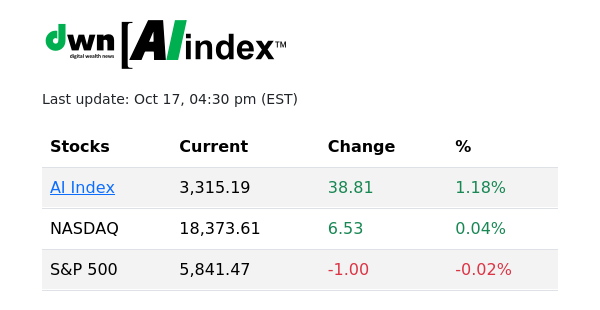
Source: thefinancials.com | Updated every 30 minutes, M-F during market hours
The DWN AI Index™ is a benchmark stock index of the artificial intelligence (AI) sector. The index is comprised of a diversified group of stocks deriving a significant percentage of their revenue from AI applications. REVIEW HISTORICALS HERE
STOCKS COMPRISING DWN AI INDEX:
Amazon (AMZN) * Arista Networks (ANET) * AI (C3.ai) * CrowdStrike Holdings (CRWD) * Duolingo (DUOL) * iRhythm Technologies (IRTC) * Microsoft Corporation (MSFT) * NVIDIA Corporation (NVDA) * Palantir Technologies (PLTR) & * Taiwan Semiconductor * Manufacturing (TSM)
Bozeman • MT • 59715 • USA
https://dwealth.news
Unsubscribe
