View in web-browser


Welcome to our weekly edition of AI & Finance™!
Hello friends, here we are again at the end of another week, this time, a week where the reality of artificial intelligence in financial services is sinking deeper into the zeitgeist. We spend some time in our AI & Finance headlines column featuring an EY study that shows AI is in demand among wealth management clients. Like, really in demand, and not just by young, aspirational, mass affluent clients, but across generations, geographies and wealth levels. We look at the big topic of big data in this week's AI Education column. In AI Regs & Risks, Greg Woolf discusses the implications of a recent pivot by Microsoft, particularly for wealth managers. Also, we discover that even during a holiday week that usually marks the beginning of the summer doldrums, AI venture capital activity remains robust... CHECK IT ALL OUT BELOW!

EY gave us some very specific, descriptive numbers regarding clients' feelings around AI, with three-fifths of investors (60%) expecting their provider to incorporate AI into their wealth management offering. Looking by demographic and geographic group, these expectations were skewed: Younger and wealthier clients had higher expectations around the use of AI than older and poorer clients. Expectations were also higher among Asian and Middle Eastern clients than North American clients. Most wealth management clients worldwide, 71% of the survey respondents, already believe that their wealth management provider is using AI to manage their wealth. Still, only 28% of clients worldwide trust AI equally as... CONTINUE HERE

Let's first try to understand traditional data in computing, which is limited in nature, usually structured and neatly stored-think tables of numbers that are clearly labeled, where the relationships between all of the numbers are well-defined and understood at the outset. Traditional data analytics can take these data sets and derive some inferences from them-perhaps even make a prediction-with long-used statistical and business intelligence methods. Big data, on the other hand, is everything else-it's large datasets that are so complex that our old-fashioned data-processing capabilities can't understand them and therefore are unable to derive any insights from them... CONTINUE HERE

Microsoft's Build 2025 keynote ended the era when Azure was synonymous with OpenAI. Satya Nadella welcomed Meta's Llama 3, Mistral's models, and Elon Musk's Grok onto the Azure AI shelf beside GPT-4, then unveiled Entra Agent ID, which gives every AI agent an employee-grade credential in Azure AD. The message: use any model you want and treat each digital worker as if it clocks in with a badge. In just two years Gen AI jumped from a single-vendor curiosity to a cloud commodity. Like databases in the 2000s, models are now swappable parts behind one API. GPUs remain scarce-Nvidia ships every H200... CONTINUE HERE

This week our announcements are led by two deals exceeding the $100 million threshold. The top reported deal, per FinSMEs, came from Lindon, Utah-based Awardco, an employee rewards platform, which raised a $165 million Series B in part to "broaden its rewards and recognition platform with additional solutions for employee engagement and performance, leverage AI to drive deeper employee insights and automations, enhance HRIS and partner integrations, and scale its global infrastructure," according to its announcement. The next biggest announcement came from the AI benchmarking space, where San Francisco-based LMArena got off to a blazing start by bringing in a whopping $100 million seed... CONTINUE HERE

Friends, as AI continues to reshape the financial landscape, this week highlights significant advancements and challenges in the sector. From major investments by leading banks to the potential upheaval in white-collar employment, the integration of AI into finance is both promising and complex. JPMorgan Chase is investing $18 billion in technology, focusing on AI to enhance productivity and reduce costs. Anthropic's CEO warns that AI could eliminate up to 50% of entry-level white-collar jobs, potentially raising unemployment to 20%. Firms like Jump, HighPeak, and Carefull are introducing AI tools to improve client services and operational efficiency. JPMorgan Chase has deployed over 100 AI... CONTINUE HERE

In this week's podcast, our dynamic AI duo - Al & Ivy - discuss the "One, Big, Beautiful Bill," breaking down its tax provisions into the good, the bad, and the ugly. The content was generated thru NotebookLM from this content source: "The Good, the Bad, and the Ugly in the One, Big, Beautiful Bill" published on Taxfoundation.org and updated on May 23, 2025. This source provides a critical analysis of a proposed tax bill, nicknamed the "One, Big, Beautiful Bill," which aims to extend parts of the 2017 tax cuts and add new provisions. The analysis breaks down the bill into categories: "The Good" highlights... CONTINUE HERE
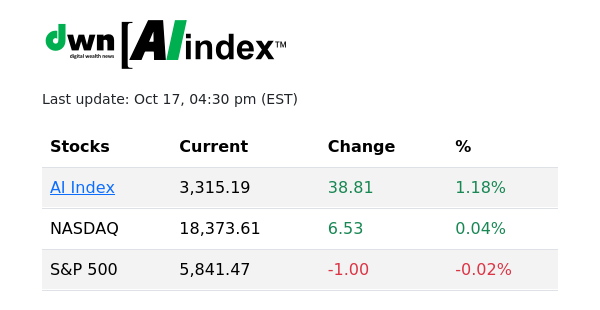
Source: thefinancials.com | Updated every 30 minutes, M-F during market hours
The DWN AI Index™ is a benchmark stock index of the artificial intelligence (AI) sector. The index is comprised of a diversified group of stocks deriving a significant percentage of their revenue from AI applications. REVIEW HISTORICALS HERE
STOCKS COMPRISING DWN AI INDEX:
Amazon (AMZN) * Arista Networks (ANET) * AI (C3.ai) * CrowdStrike Holdings (CRWD) * Duolingo (DUOL) * iRhythm Technologies (IRTC) * Microsoft Corporation (MSFT) * NVIDIA Corporation (NVDA) * Palantir Technologies (PLTR) & * Taiwan Semiconductor * Manufacturing (TSM)
Bozeman • MT • 59715 • USA
https://dwealth.news
Unsubscribe
